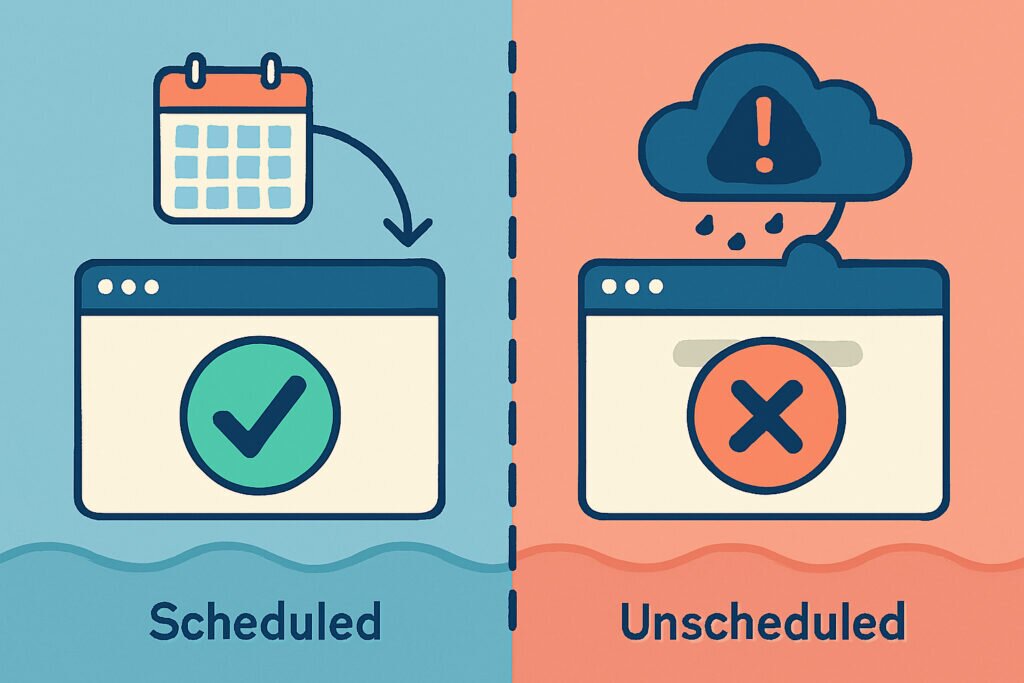
If you’ve ever been jolted awake by an alert that your website is down, you already know there’s a world of difference between planned maintenance and an unexpected crash. Understanding the distinction between scheduled and unscheduled downtime isn’t just technical jargon—it’s essential for protecting your business reputation, customer trust, and bottom line.
What Is Scheduled Downtime?
Scheduled downtime is when you deliberately take your website or service offline for planned maintenance, updates, or improvements. Think of it like closing a physical store for renovations—you choose the timing, inform your customers in advance, and control the entire process.
This type of downtime includes activities like server upgrades, database optimization, security patches, major software updates, or infrastructure migrations. The key characteristic is control. You decide when it happens, how long it lasts, and you can prepare your users beforehand.
I learned this lesson the hard way back when I was managing a client’s e-commerce site. We pushed a major update during business hours without warning, and the site went down for forty minutes during their peak shopping period. The angry emails and lost sales taught me that even necessary maintenance needs proper planning and communication.
What Is Unscheduled Downtime?
Unscheduled downtime is the nightmare scenario—your site goes offline without warning due to server failures, network issues, cyber attacks, software bugs, or infrastructure problems. There’s no preparation time, no advance notice to customers, and often no clear timeline for resolution.
This is the kind of outage that wakes you up at 3 AM or ruins your weekend. It’s unpredictable, uncontrolled, and usually happens at the worst possible moment. While scheduled downtime might be an inconvenience, unscheduled downtime is a genuine crisis.
The Impact on Your Business
The business consequences of these two types of downtime differ dramatically. With scheduled maintenance, you can minimize damage by choosing low-traffic periods—perhaps late night or early morning hours when fewer users are active. You can send notifications via email, post warnings on your site, and set up status pages to keep everyone informed.
Unscheduled outages, however, hit whenever they want. Peak shopping hours, product launch day, during important demonstrations—Murphy’s Law seems to apply with brutal efficiency. I’ve watched businesses lose thousands in revenue during unexpected outages that lasted only an hour.
Beyond immediate lost revenue, unscheduled downtime damages customer trust. One study found that 88% of users are less likely to return to a website after a bad experience, and unexpected downtime definitely qualifies as a bad experience. Your customers don’t care about your technical excuses—they just know your service wasn’t there when they needed it.
Financial Costs: A Clear Comparison
Scheduled downtime typically costs less because you can plan around it. You might schedule maintenance during your slowest traffic period, reducing potential lost revenue to nearly zero. You also have time to prepare backup systems and ensure smooth restoration.
Unscheduled downtime, by contrast, carries massive hidden costs. Beyond direct revenue loss, consider emergency support costs, potential SLA violation penalties, overtime for technical staff, rushed fixes that might create new problems, and long-term customer churn. Industry estimates suggest unscheduled downtime can cost businesses anywhere from $5,600 to over $100,000 per hour, depending on company size and sector.
How Monitoring Helps Prevent Both Types
While you can’t eliminate all downtime, proper monitoring drastically reduces both types. For scheduled maintenance, monitoring helps you choose optimal timing by analyzing traffic patterns and identifying your quietest periods. You can also verify that systems are fully operational after maintenance completes.
For unscheduled downtime, continuous monitoring is your early warning system. Services like UptimeVigil check your website every minute, alerting you immediately when problems occur. This rapid notification can transform a potential three-hour outage into a fifteen-minute incident because you catch and fix issues before they escalate.
Real-time response time tracking also helps you spot developing problems before they become full outages. If your site starts slowing down, that’s often a warning sign that something’s wrong. Catching these early signals means you can schedule maintenance to fix the issue rather than waiting for a catastrophic failure.
Best Practices for Managing Scheduled Downtime
When you need planned maintenance, communicate early and often. Give users at least 48 hours notice for significant maintenance windows. Create a detailed maintenance plan with specific time estimates and rollback procedures if things go wrong.
Choose your timing wisely by analyzing your traffic data to find the absolute quietest periods. For many businesses, this might be Sunday at 2 AM, but your specific patterns could differ. Always have a tested backup plan and make sure you can quickly restore service if something unexpected happens during maintenance.
Common Myths About Downtime
One persistent myth is that ”a little downtime doesn’t matter.” In reality, even brief outages affect SEO rankings, customer perception, and revenue. Search engines notice when sites are frequently unavailable, and users remember bad experiences.
Another misconception is that only large enterprises need to worry about monitoring and uptime. Small businesses often face proportionally greater impact from outages because they have fewer resources and smaller customer bases where every lost sale matters more.
Frequently Asked Questions
How much scheduled downtime is acceptable? Most modern websites aim for 99.9% uptime or better, which allows roughly 8.76 hours of total downtime per year. Schedule maintenance carefully to stay within these limits.
Can all unscheduled downtime be prevented? Not entirely, but comprehensive monitoring, redundant systems, and proactive maintenance can reduce unscheduled outages by 60-80% compared to reactive-only approaches.
Should I inform customers about brief scheduled maintenance? Yes, even for quick updates. Transparency builds trust, and unexpected ”something went wrong” messages frustrate users even if you planned the downtime.
The fundamental difference boils down to this: scheduled downtime is a controlled inconvenience you manage strategically, while unscheduled downtime is an emergency crisis you fight to minimize. Smart businesses invest in monitoring and preventive maintenance to maximize the former and eliminate as much of the latter as possible.