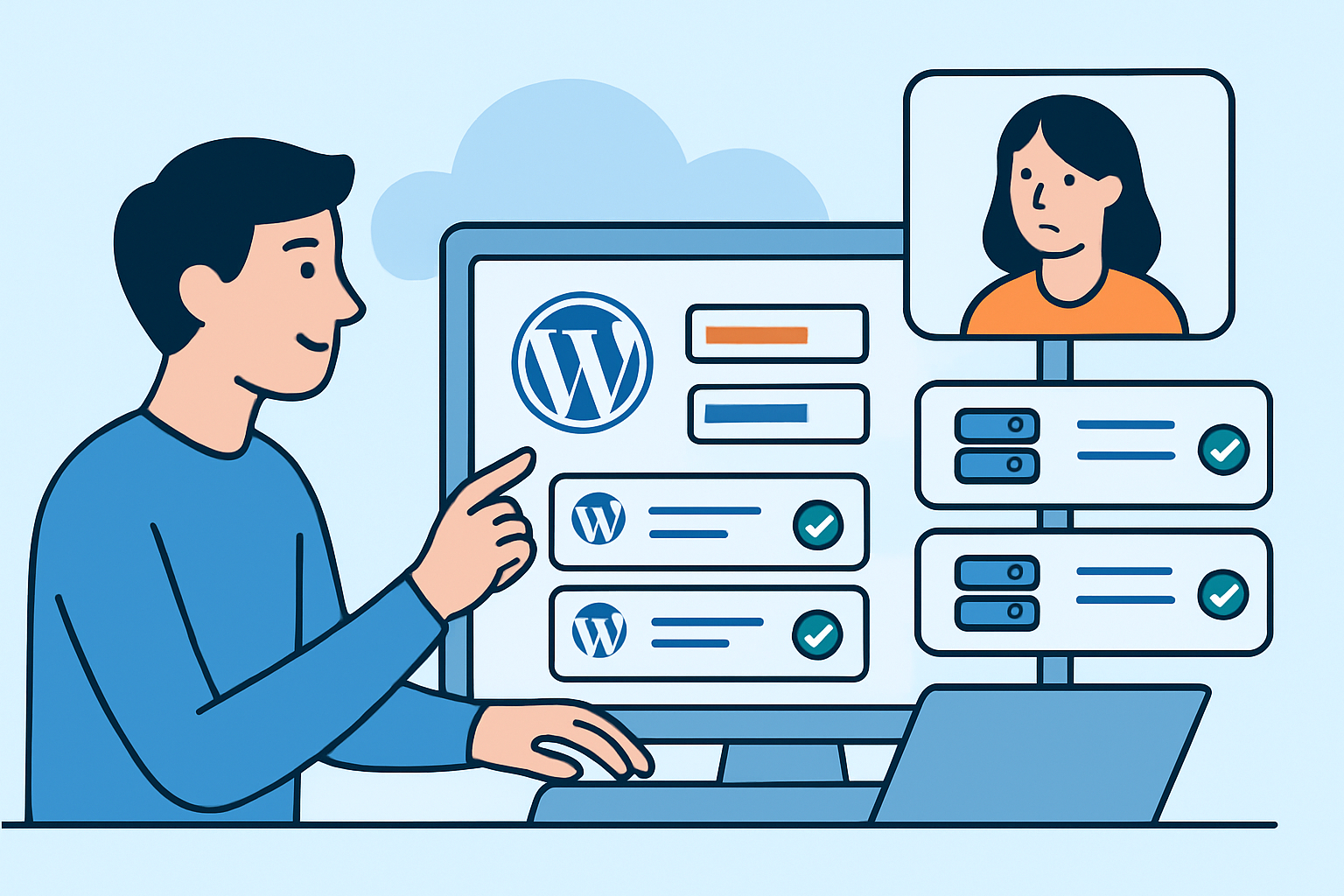
Running a web agency usually means juggling dozens, sometimes hundreds, of WordPress installs across different hosts, plugin stacks, and client expectations. Monitoring for agencies managing many WordPress sites isn’t just about knowing when something breaks – it’s about catching problems before a client notices, keeping your team’s attention on the sites that actually need it, and having proof of reliability when a contract renewal conversation comes up.
Why WordPress agencies face a different monitoring problem
A single-site owner checks their site occasionally and reacts when something looks off. An agency can’t operate that way. With 50 or 150 WordPress installs under management, plugin conflicts, failed auto-updates, expired SSL certificates, and hosting hiccups happen constantly – just not all on the same day, or the same site.
The real challenge isn’t detecting one outage. It’s detecting the right outage, fast, out of a portfolio where most sites are fine at any given moment. Without a system built for scale, agencies end up either missing issues entirely or drowning in noise from monitors that fire for every minor blip.
What actually goes wrong on managed WordPress sites
A few patterns show up again and again in agency environments:
Plugin or theme updates that silently break a page – the site returns a 200 status but renders a fatal error or white screen, which basic ping checks won’t catch.
Shared hosting resource limits – one noisy client site on a shared server drags down response times for neighboring sites on the same plan.
Expired or misconfigured SSL certificates after a domain transfer or hosting migration, often discovered only when a client calls asking why their browser shows a security warning.
Login and wp-admin lockouts caused by security plugins, brute-force protection rules, or a bad .htaccess rewrite pushed during a deploy.
None of these are exotic. They’re routine, and they’re exactly why a portfolio-wide monitoring approach beats checking sites manually or waiting for client complaints.
Setting up monitoring that scales with your client list
The practical approach is to treat every client site as its own monitored asset, not as an afterthought bundled into a hosting dashboard. A few steps make this manageable even as the list grows:
Start with HTTP monitoring on the homepage and at least one or two critical inner pages – a checkout page, a booking form, or a login screen, depending on what the client’s site actually does. A homepage returning 200 tells you very little if the contact form underneath it is silently broken.
Layer in SSL certificate monitoring across the whole portfolio. Certificate expiry is one of the most preventable outages in web operations, yet it’s still one of the most common – see what every website owner should know about TLS certificates for the mechanics of why this keeps happening.
Group monitors by client or by hosting provider rather than one flat list. When a shared host has an incident, you want to see it as a pattern across five client sites, not five unrelated alerts.
Set response time thresholds that reflect what’s normal for each site, not a single global number. A marketing brochure site and a WooCommerce store don’t have the same acceptable baseline.
For agencies specifically, checking uptime across a large domain list one by one is a losing strategy. Tracking uptime across multiple domains from a single dashboard is what makes a 100-site portfolio manageable instead of overwhelming.
Alert routing: the part agencies get wrong most often
Sending every alert to every team member is a fast way to make people ignore alerts entirely. A better structure routes notifications based on who owns the client relationship and what the issue actually is.
A practical setup looks like this: infrastructure-level alerts (full outage, DNS failure) go to whoever’s on support duty that day. Performance degradation alerts (slow response times, not full downtime) go to a shared queue reviewed once or twice daily rather than paged immediately. Client-specific escalations – like a payment page failing – go directly to the account manager as well as support, since that’s a conversation the client will likely raise first.
This tiered approach avoids the common trap of alert fatigue, where genuine emergencies get lost in a flood of low-priority notifications. It’s worth reviewing your notification rules every few months as the client list changes, since a routing setup built for 20 sites often breaks down at 80.
Turning monitoring data into client-facing value
One thing agencies consistently underuse: monitoring data isn’t just an internal safety net, it’s proof of the work you’re doing. Uptime percentages, average response times, and incident history give you something concrete to show clients during a quarterly review, rather than a vague “everything’s been fine.”
Building this into a recurring habit – rather than pulling numbers manually when someone asks – saves time and makes the reporting consistent across your whole client base. Creating a monthly uptime report for clients turns raw monitoring logs into something a non-technical stakeholder can actually read and appreciate.
A common misconception worth correcting
Many agencies assume that because their hosting provider offers a status dashboard or uptime guarantee, they don’t need independent monitoring. This is backwards. Hosting-level monitoring only tells you the server is running – it says nothing about whether WordPress itself is functioning, whether a plugin update broke a specific page, or whether the site is reachable from outside the host’s own network.
Independent, external monitoring checks the site the way a real visitor would: from outside the hosting environment, hitting the actual pages that matter. That’s the only way to catch the gap between “server is up” and “site actually works,” which is where most WordPress incidents live. For a deeper look at platform-specific pitfalls, WordPress site monitoring best practices covers the plugin and update-related failure points in more detail.
FAQ
How many monitors does an agency actually need per WordPress site?
At minimum, one for the homepage and one for each business-critical page – checkout, contact form, login, or booking flow. Sites with e-commerce or membership features usually warrant two to four monitors each to cover the full functional path, not just whether the server responds.
Should every client alert go to the same support inbox?
No. Splitting alerts by severity and by client ownership prevents fatigue and makes sure the account manager knows about client-facing issues before the client calls to report them.
Is checking a WordPress admin dashboard enough to catch outages?
Not reliably. Admin dashboards reflect what the server thinks is happening, not what an external visitor experiences. A site can appear healthy internally while returning errors or timing out for real users, which is why external, minute-by-minute checks matter.
Managing many WordPress sites at once comes down to systems, not vigilance. Build monitoring into the onboarding process for every new client site from day one, route alerts by who needs to act, and use the resulting data both to catch problems early and to show clients the reliability they’re paying for.