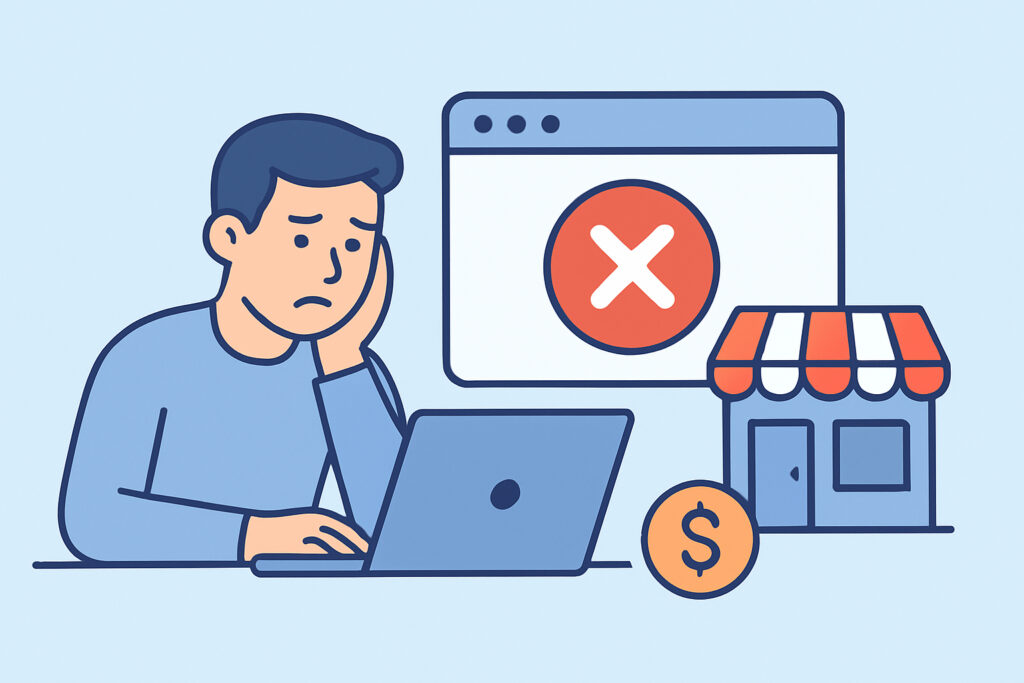
Website downtime can destroy a small business faster than most owners realize, with costs extending far beyond lost sales to include damaged reputation, customer churn, and missed opportunities. Understanding the real cost of website downtime for small businesses requires looking beyond immediate revenue losses to examine the long-term impact on growth, customer relationships, and competitive positioning.
Small businesses face unique vulnerabilities when their websites go down. Unlike large enterprises with diversified revenue streams and dedicated IT teams, a single point of failure can cripple operations entirely. The financial impact compounds quickly, especially during peak business hours or critical sales periods.
Immediate Revenue Loss and Transaction Failures
The most visible cost hits immediately when transactions fail. An e-commerce site processing $10,000 in daily sales loses roughly $417 per hour during downtime. However, this calculation only scratches the surface of actual losses.
Consider a local restaurant with online ordering during lunch rush. A 30-minute outage between 11:30 AM and noon doesn’t just cost the orders that would have come in during those 30 minutes. Hungry customers calling to find busy phone lines or visiting competitor websites may never return. The ripple effect extends throughout the day as word spreads about the unreliable service.
Transaction failures create particularly damaging scenarios. Customers entering payment information only to encounter error messages often assume the site is compromised or poorly maintained. Even after service restoration, conversion rates typically remain depressed for hours or even days as customer confidence recovers slowly.
Customer Acquisition Cost Multiplication
Many small business owners overlook how downtime multiplies customer acquisition costs. When paid advertising campaigns drive traffic to an inaccessible website, every click becomes wasted spend. A local service business running Google Ads at $3 per click during a two-hour morning outage might waste $200-300 in advertising spend while simultaneously creating negative first impressions.
The timing amplifies this waste. Downtime during high-intent moments – when customers are actively searching for solutions – costs significantly more than downtime during off-peak hours. A tax preparation service going down during tax season or a gift shop failing on Valentine’s Day faces disproportionate losses compared to the same outage during slow periods.
Recovery requires additional marketing investment to rebuild momentum. Customers who encountered downtime need multiple positive touchpoints before trusting the business again, effectively doubling or tripling the cost to convert those prospects.
Search Engine Ranking Penalties
Search engines prioritize reliable websites, and repeated downtime incidents damage SEO rankings that took months or years to build. Google’s algorithms interpret frequent unavailability as poor user experience, gradually demoting affected sites in search results.
The SEO impact proves particularly devastating for small businesses relying on local search traffic. A plumbing company dropping from position 3 to position 8 for “emergency plumber near me” might lose 60-70% of organic click-through traffic. Recovering those rankings requires extensive SEO work and often takes 3-6 months of consistent uptime and optimization.
Competitive displacement accelerates the problem. While one business suffers downtime, competitors capture its search visibility and customer attention. Small markets offer limited opportunities to recover lost ground, making prevention crucial for maintaining competitive position.
Operational Disruption Beyond the Website
Modern small businesses integrate their websites deeply into operations, making downtime disruptive across multiple business functions. Online appointment booking, customer communication portals, inventory management systems, and staff scheduling tools often depend on website availability.
A dental practice using web-based appointment scheduling faces cascading operational problems during downtime. Patients can’t book appointments, staff can’t access schedules, and phone volumes spike as frustrated customers call directly. The practice may need to deploy additional staff to handle increased call volume, pay overtime for schedule reconstruction, and manage appointment conflicts once systems restore.
Service businesses with field technicians face similar challenges. If customer portals containing job details, contact information, or special instructions become unavailable, technicians may arrive unprepared or unable to complete scheduled work. This leads to return visits, customer dissatisfaction, and reduced daily productivity.
The Trust Erosion Factor
Customer trust, painstakingly built over months or years, erodes rapidly during website outages. The psychology of user trust reveals how quickly perceptions shift when reliability fails. Small businesses, lacking the brand recognition that might excuse occasional problems, cannot afford trust erosion.
B2B relationships prove especially fragile. A consulting firm whose website fails during a potential client’s research phase sends clear signals about operational competence and attention to detail. Business buyers, already skeptical about working with smaller vendors, interpret downtime as evidence of insufficient resources or poor management.
One common misconception suggests that brief outages don’t impact customer relationships significantly. However, research shows that even single negative experiences create lasting impressions, with customers requiring 5-12 positive interactions to overcome one negative incident.
Recovery requires deliberate trust-rebuilding efforts. Transparent communication about outage causes, implemented preventive measures, and consistent reliability over extended periods gradually restore confidence. However, this process demands time and resources that many small businesses struggle to allocate.
Hidden Costs of Downtime Response
Emergency response activities generate substantial hidden costs that small business owners rarely calculate. When websites fail, owners or staff drop everything to troubleshoot, contact hosting providers, communicate with customers, and coordinate repairs.
A small agency owner spending four hours diagnosing and resolving a hosting issue loses billable time worth $200-400, plus opportunity costs from delayed client projects. If multiple team members get involved, costs multiply quickly. Emergency hosting changes, expedited technical support, or consultant fees add direct expenses to the time investment.
The stress factor cannot be ignored either. Business owners juggling multiple responsibilities while managing website crises often make poor decisions under pressure. Hasty hosting changes, quick fixes that create new problems, or panic-driven technical decisions frequently cost more than the original outage.
Industry-Specific Impact Variations
Different business types experience varying downtime impacts based on customer behavior patterns and competitive dynamics. Professional services firms may weather brief outages better than e-commerce sites, but longer disruptions damage credibility more severely.
Time-sensitive businesses face amplified costs. Food delivery services, event ticket sales, or appointment-based services lose customers permanently during outages because alternatives exist everywhere. These businesses often cannot reschedule lost opportunities, making prevention their only viable strategy.
Seasonal businesses experience concentrated vulnerability. A holiday decoration retailer going down during peak shopping season loses irreplaceable revenue opportunities. Unlike year-round businesses that can make up lost sales over time, seasonal operators must maximize limited high-demand windows.
Prevention Investment vs. Downtime Costs
The mathematics of prevention versus reaction strongly favor proactive monitoring approaches. Proactive website monitoring costs typically range from $10-50 monthly for small businesses, while single downtime incidents often cost hundreds or thousands of dollars in lost revenue, time, and opportunities.
Professional monitoring services detect issues within minutes, enabling rapid response before customers notice problems. Manual monitoring approaches, where business owners occasionally check their websites, miss most outages and delay problem resolution significantly.
The prevention investment covers more than just immediate problem detection. Quality monitoring identifies performance degradation trends, SSL certificate expiration risks, and third-party dependency failures before they cause complete outages. This early warning capability prevents many incidents entirely.
Frequently Asked Questions
How long does it take for customers to lose trust after a website outage?
Trust erosion begins immediately when customers encounter unavailable websites. Studies indicate that 40% of users abandon sites that take longer than 3 seconds to load, and complete unavailability creates much stronger negative impressions. Rebuilding trust typically requires 2-3 months of consistent reliability and positive interactions.
What’s the average cost of downtime for small e-commerce businesses?
Small e-commerce sites lose approximately $300-1,000 per hour during peak periods, including direct sales losses, wasted advertising spend, and customer acquisition cost increases. However, long-term impacts from lost customers and damaged SEO rankings often exceed immediate revenue losses by 3-5 times.
Can small businesses recover quickly from major downtime incidents?
Recovery speed depends on business type, customer loyalty, and competitive intensity. Service businesses with established relationships may recover within weeks, while e-commerce sites in competitive markets might need 3-6 months to regain lost ground. Swift, transparent communication and reliability improvements accelerate recovery significantly.
Building Resilience Through Preparation
Understanding downtime costs enables small business owners to make informed decisions about prevention investments and response strategies. The real cost extends far beyond immediate revenue losses to encompass customer relationships, competitive positioning, operational efficiency, and long-term growth potential.
Successful small businesses treat website reliability as a core operational requirement, not an optional upgrade. They invest in monitoring systems, maintain relationships with reliable hosting providers, and develop incident response procedures before problems occur. This proactive approach transforms potential disasters into manageable inconveniences while preserving the customer trust that small businesses cannot afford to lose.