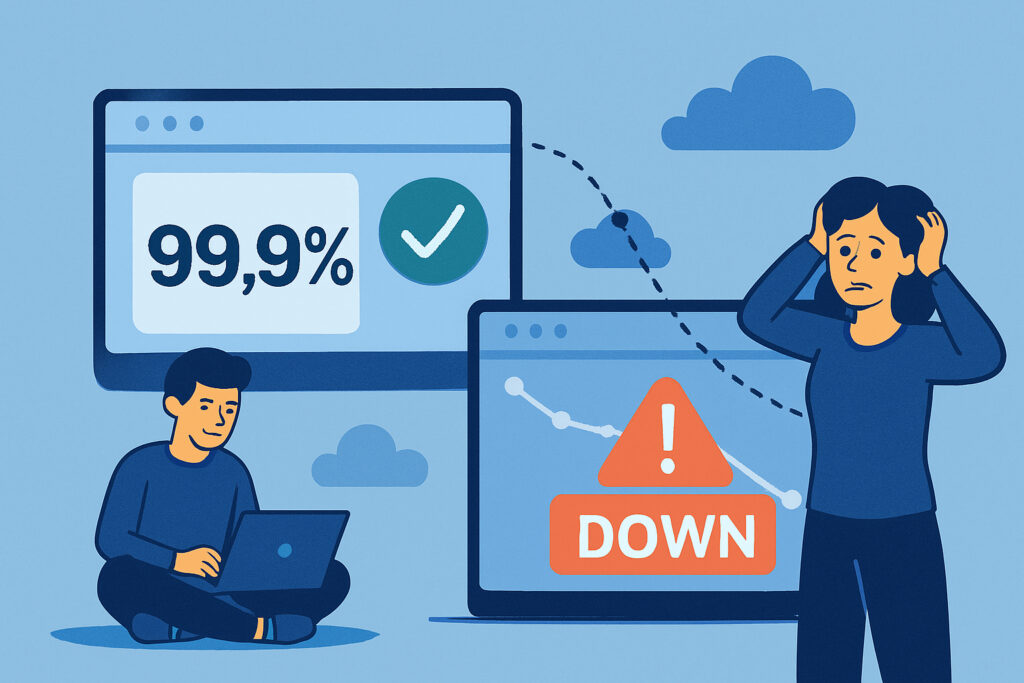
When shopping for website hosting or monitoring services, you’ve probably seen providers proudly advertising “99.9% uptime guarantee” as if it’s the gold standard. And honestly, it sounds pretty impressive at first glance. Nearly 100% availability? What could go wrong? But here’s the reality that most businesses don’t realize until it’s too late: that seemingly tiny 0.1% can actually translate into significant downtime that hurts your bottom line, frustrates your customers, and damages your reputation.
Let me break down exactly why 99.9% uptime isn’t the reassuring promise it appears to be, and what you should actually be looking for instead.
The Math Behind 99.9% Uptime
Let’s start with the numbers, because they tell a sobering story. When a provider guarantees 99.9% uptime, they’re essentially saying your website can be down for up to 43.2 minutes every month. That’s over 8 hours per year. For an e-commerce site, that could mean thousands of dollars in lost sales. For a SaaS platform, it means frustrated users and potential cancellations.
I learned this the hard way a few years back when I was running an online booking system. We had a “reliable” hosting provider with 99.9% uptime, and everything seemed fine until we experienced three separate outages in a single month. Each lasted about 15 minutes. Technically, they were still within their SLA, but we lost bookings, fielded angry customer calls, and our reputation took a hit. The math might allow it, but your customers won’t care about percentages when they can’t access your service.
When Downtime Happens Matters Most
Here’s another critical point that gets overlooked: not all downtime is created equal. If your website goes down at 3 AM on a Tuesday, you might barely notice. But what if it crashes during your peak hours, like Black Friday for retail sites or during a product launch? What if you’re running paid advertising that’s driving traffic to a site that’s unreachable?
The 99.9% calculation doesn’t distinguish between these scenarios. Your hosting provider can hit their target even if all the downtime occurs during your busiest periods. I’ve seen businesses lose entire promotional campaigns because their site went down right when their email blast hit thousands of inboxes.
The Hidden Costs of “Acceptable” Downtime
Beyond immediate lost revenue, there are secondary costs that pile up quickly. Every minute your site is down, you’re potentially losing search engine rankings. Google doesn’t like unreliable websites, and repeated outages can push you down in search results, costing you organic traffic for weeks or months afterward.
Customer trust is another casualty. In today’s competitive market, users have short attention spans and plenty of alternatives. If someone tries to visit your site and finds it down, they’ll likely click over to a competitor. Many won’t come back. One study found that 88% of online consumers are less likely to return to a site after a bad experience, and downtime definitely qualifies as a bad experience.
There’s also the internal cost of dealing with outages. Your team has to stop what they’re doing to troubleshoot, communicate with customers, and manage the crisis. That’s productive time lost that could have been spent on growth activities.
99.9% vs Higher Uptime Standards
So what should you be looking for instead? Let’s compare:
99.9% uptime: 43.2 minutes downtime per month
99.95% uptime: 21.6 minutes downtime per month
99.99% uptime: 4.32 minutes downtime per month
99.999% uptime: 26 seconds downtime per month
The difference between 99.9% and 99.99% might look minimal on paper, but it’s a factor of ten reduction in actual downtime. For critical business applications, this matters enormously.
The Myth of “Good Enough” Reliability
Many businesses fall into the trap of thinking 99.9% is “good enough” because it’s the industry standard. But here’s the thing: your customers don’t care about industry standards. They care about whether your service works when they need it.
I’ve talked to countless site owners who chose cheaper hosting because “99.9% seemed fine” only to regret it later when dealing with the consequences. The money saved on hosting gets quickly eaten up by lost sales, customer service costs, and reputation management.
What to Look for in a Monitoring Service
Instead of just accepting whatever uptime guarantee your host offers, you need visibility into what’s actually happening. A proper monitoring service checks your site every minute (or even more frequently) and alerts you instantly when problems occur. This means you can respond immediately rather than discovering hours later that you’ve been down.
Look for monitoring that tracks not just whether your site is up or down, but also response times, SSL certificate status, and specific functionality. Sometimes a site might technically be “up” but loading so slowly that it’s effectively useless to visitors.
Questions to Ask Your Provider
Before committing to any hosting or monitoring service, ask these specific questions:
What exactly counts as “downtime” in your SLA? Some providers only count complete outages, not performance degradation.
How is uptime measured and reported? Request access to historical data.
What compensation do you offer when uptime falls below the guarantee? Many SLAs offer credit, but is it worth the hassle of claiming it?
What’s your average uptime, not just your guaranteed minimum? There’s often a significant gap.
How quickly do you detect and respond to issues? Response time matters as much as total downtime.
The Bottom Line
99.9% uptime sounds great in marketing materials, but when you break down what it actually means for your business, it’s often not acceptable. Those 43 minutes of downtime each month can cost you far more than the difference between budget hosting and premium services.
Your website is often your primary customer touchpoint. It’s worth investing in reliability that goes beyond the bare minimum. Look for providers offering 99.95% or higher, implement robust monitoring that checks your site every minute, and have a plan for responding quickly when issues do occur.
Remember, in the digital world, every minute of downtime is a minute your competitors are capturing your potential customers. Don’t settle for “good enough” when your business reputation and revenue are on the line.